Showing posts with label A Level Chemistry. Show all posts

Friday, 12 April 2019

Hydrolysis of Haloalkanes

Haloalkanes react with aqueous NaOH to form alcohols. the mechanism for which, is nucleophilic substitution:
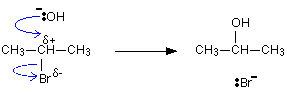
Image result for nucleophilic substitution halogenoalkanes

In this mechanism, the hydroxide ion acts as a nucleophile because it is donating an electron pair the the partially positive carbon atom. The hydroxide ion attacks the carbon from the opposite side to which the halogen is bonded because the bromine is very large in comparison, making it nigh on impossible for the nucleophile to attack from the front. 

The carbon atom is then making 5 bonds (10 bonding electrons in total), but it can only accommodate 8 electrons in its valence shell, therefore the bromine leaves as the C - Br bond breaks by heterolytic fission as the bromine comes away with both of the electrons from the bonding pair. 

The resulting solution contains alcohol, excess hydroxide and halide (in this case bromide) ions. 

From the perspective of organic synthesis, this reaction is a useful transition from haloalkane to alcohol, but from an organic analysis perspective, this reaction can also be used to identify the type of haloalkane when combined with another subsequent step. However, this is a destructive analytical technique and you will not get your sample back!

To test for the type of halogen in your haloalkane, you must firstly add nitric acid (HNO3) to your reaction mixture. This will remove any other species that could give a false positive result in the next step. You then ad silver nitrate (AgNO3). This will produce precipitates of various different colours:


From left to right:
  • Iodide produces a yellow precipitate ( I-aq) + Ag+(aq) --> AgI(s) )
  • Iodide produces a yellow precipitate ( Br-aq) + Ag+(aq) --> AgBr(s) )
  • Iodide produces a yellow precipitate ( Cl-aq) + Ag+(aq) --> AgCl(s) )
So, finally, an example to summarise the above: a sample of a haloalkane can be hydrolysed to substitute the halogen for an OH group. The resulting solution contains halides which can be tested from with nitric acid and silver nitrate. The colour of the precipitate formed can be used to identify the halogen present in the haloalkane. 

In a subsequent post, I will cover explaining the rate of hydrolysis of haloalkanes. 

Monday, 8 April 2019

The Significance of Optical Isomers

Firstly, sorry the blog has been a bit dead - I've been flat out with work and life commitments!

Optical isomerism is a discovery made by French Physicist Jean-Baptist Biot. It essentially means that any carbon atom in a molecule which is bended to four different groups may from two different versions of that molecule (enantiomers).

These two  which are non-superimposable mirror images of each other, as shown by the example below; the infamous thalidomide:

Image result for thalidomide


Thalidomide was a drug which was originally licensed in 1958. Its primary use was to treat morning sickness in pregnant women. It was not known that thalidomide was optically active. The R enantiomer (shown above) was useful in treating morning sickness, whilst the S enantiomer led to the birth of babies with shortened limbs. For this reason, thalidomide's license was withdrawn in 1961.

Another, less extreme example of optical isomerism is carvone:

Image result for r and s carvone

R-carvone is used in chewing gum, because is has the taste and aroma of spearmint. S-carvone however, has a radically different aroma and taste - caraway (similar to dill and parsley). 

Imagine a batch of chewing gum made with a racemic mixture (50:50 of each enantiomer) of carvone.... eughhhhh!

Wednesday, 5 December 2018

A Level - Exam Technique: Shapes of Molecules

Shapes of molecules can be difficult, but there are several key criteria to hit in an exam question that will help you maximise your marks:

  • number of bonding pairs
  • number of lone pairs
  • electron pairs repel
  • strength of bond pair - bond pair repulsion vs. bond pair - lone pair repulsion
  • bond angle and/or shape
For example, consider this question about ammonia:


Q11. a) State and explain the bond angle and shape of an ammonia molecule
(4 marks)

In the following answer, I have broken each marking point down by alternating colours, and each relates to the points listed above. 

Ammonia contains 3 bonding pair and 1 lone pair. The electron pairs repel, but the bond pair - bond pair repulsion is weaker than the bond pair - lone pair repulsion, therefore constricting the bond angle to 107° and making the shape pyramidal. 

So, if you follow the logic of addressing those 5 points above then you won't go far wrong in an exam situation - good luck!

Monday, 15 October 2018

A Level - spd Notation of Transition Elements

The transition elements all have valence electrons in a d sub-shell, which is part of the reason that they make such good catalysts and form coloured solutions of their ions. 

Depending upon your exam board, a transition element is either defined as an element which forms ions with an incomplete d sub-shell or a element with an incomplete d sub-shell. Personally, I settle with the former definition, and for that reason both zinc (Zn) and scandium (Sc) are not classed as transition elements.


The electron configuration of scandium (Sc, above) shows that the 3d sub-shell contains only one electron. Scandium only forms Sc+ ions by losing the 3d electron as it has the highest energy, thus forming an ion without an incomplete d sub shell - not a transition element!


The story is similar for zinc (Zn, above), which forms Zn2+ ions, by losing the two electrons in the 4s, forming an ion with a complete 3d sub-shell - not a transition element! It loses the 4s electrons and not the 3d because it more energetically beneficial for it to have an empty 4s sub-shell and a full 3d sub-shell than it is for it to have a full 4s sub-shell and a partially-full 3d sub-shell. 

Now we have covered the elements in the series that are exempt from the title of 'transition element', let's turn out attention to Ti - Zn. By the time we get to chromium (Cr), there are 4 electrons in the 3d sub-shell and 2 still in the 4s:


However, the 3d sub-shell is really close to being half-full which would impart some stability (release some energy). As the energy gap between 3d and 4s is only very small, the energy required to promote a 4s electron to the 3d sub-shell in order to half-fill it is comparable to the energy released by half-filling it, therefore, this is exactly what happens:


Thus making the electron configuration of chromium 1s22s22p63s23p64s13d5.


A similar phenomenon happens for copper, where the 3d can be completely filled by promoting a 4s electron:


This makes copper's electron configuration 1s22s22p63s23p64s13d10.

So, in summary:
  • Zinc and scandium are sometimes not considered transition metals as their ions do not have an incomplete d sub-shell. 
  • Chromium promotes a 4s electron to half-fill the 3d sub-shell. 
  • Copper promotes a 4s electron to fill the 3-d sub-shell completely. 


Sunday, 7 October 2018

A Level - Electron Configuration and spd Notation

Starting where the last blog left off, you hopefully remember that electrons are pair with opposite spin in orbitals, which sit within sub-shells, within shells described by the principle quantum number (n). We can show electron configurations on an energy diagram as shown below:


When it comes to assigning electrons to orbitals, the simplest atom is hydrogen (H), which has one electron in the 1s sub-shell, as shown below:


The single electron is placed in the lowest energy orbital (1s) first, and denoted here by an arrow, with the direction, up or down, showing the spin. In helium (He), the second electron has opposite spin (down-spin) and is paired with another electron in the 1s:


By the time we get to nitrogen, each p orbital contains one electron, and the 2p sub-shell is half-full. This imparts some stability, which is something that ties into ionisation energies:


Oxygen has one more electron, which is paired with one of the electrons already in the 2p sub-shell with opposite spin: 


The diagrams above are a good way of visualising the arrangement of orbitals, however, it would be extremely lengthy to draw out every time. We usually represent the electron configuration of a substance spd notation, as shown below:

So this means that the spd notation of oxygen is 1s22s22p4.

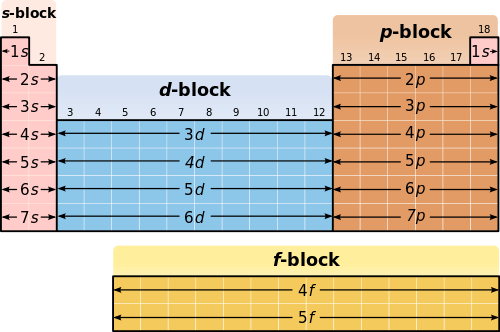
The periodic table can be separated into three blocks; s, p and d blocks. The s-block is comprised of elements who's last sub-shell is an s sub-shell and so on...


So, if we pick out phosphorus (P) for example, as we know it is in the p block, its last occupied sub-shell would be the 3p and as it is three places into the p block, the 3p sub-shell would have an occupancy of 3, so 3p3. Overall the spd notation of phosphorus would be 1s22s22p63s23p3.

In summary:
  • Electrons fill the lowest energy sub-shell first.
  • Electrons fill sub-shells until they are half full and then pair with electrons of opposite spin to fill the sub-shell.
  • An element's position in the periodic table can tell you its electron configuration.