Showing posts with label configuration. Show all posts

Monday, 15 October 2018

A Level - spd Notation of Transition Elements

The transition elements all have valence electrons in a d sub-shell, which is part of the reason that they make such good catalysts and form coloured solutions of their ions. 

Depending upon your exam board, a transition element is either defined as an element which forms ions with an incomplete d sub-shell or a element with an incomplete d sub-shell. Personally, I settle with the former definition, and for that reason both zinc (Zn) and scandium (Sc) are not classed as transition elements.


The electron configuration of scandium (Sc, above) shows that the 3d sub-shell contains only one electron. Scandium only forms Sc+ ions by losing the 3d electron as it has the highest energy, thus forming an ion without an incomplete d sub shell - not a transition element!


The story is similar for zinc (Zn, above), which forms Zn2+ ions, by losing the two electrons in the 4s, forming an ion with a complete 3d sub-shell - not a transition element! It loses the 4s electrons and not the 3d because it more energetically beneficial for it to have an empty 4s sub-shell and a full 3d sub-shell than it is for it to have a full 4s sub-shell and a partially-full 3d sub-shell. 

Now we have covered the elements in the series that are exempt from the title of 'transition element', let's turn out attention to Ti - Zn. By the time we get to chromium (Cr), there are 4 electrons in the 3d sub-shell and 2 still in the 4s:


However, the 3d sub-shell is really close to being half-full which would impart some stability (release some energy). As the energy gap between 3d and 4s is only very small, the energy required to promote a 4s electron to the 3d sub-shell in order to half-fill it is comparable to the energy released by half-filling it, therefore, this is exactly what happens:


Thus making the electron configuration of chromium 1s22s22p63s23p64s13d5.


A similar phenomenon happens for copper, where the 3d can be completely filled by promoting a 4s electron:


This makes copper's electron configuration 1s22s22p63s23p64s13d10.

So, in summary:
  • Zinc and scandium are sometimes not considered transition metals as their ions do not have an incomplete d sub-shell. 
  • Chromium promotes a 4s electron to half-fill the 3d sub-shell. 
  • Copper promotes a 4s electron to fill the 3-d sub-shell completely. 


Sunday, 7 October 2018

A Level - Electron Configuration and spd Notation

Starting where the last blog left off, you hopefully remember that electrons are pair with opposite spin in orbitals, which sit within sub-shells, within shells described by the principle quantum number (n). We can show electron configurations on an energy diagram as shown below:


When it comes to assigning electrons to orbitals, the simplest atom is hydrogen (H), which has one electron in the 1s sub-shell, as shown below:


The single electron is placed in the lowest energy orbital (1s) first, and denoted here by an arrow, with the direction, up or down, showing the spin. In helium (He), the second electron has opposite spin (down-spin) and is paired with another electron in the 1s:


By the time we get to nitrogen, each p orbital contains one electron, and the 2p sub-shell is half-full. This imparts some stability, which is something that ties into ionisation energies:


Oxygen has one more electron, which is paired with one of the electrons already in the 2p sub-shell with opposite spin: 


The diagrams above are a good way of visualising the arrangement of orbitals, however, it would be extremely lengthy to draw out every time. We usually represent the electron configuration of a substance spd notation, as shown below:

So this means that the spd notation of oxygen is 1s22s22p4.

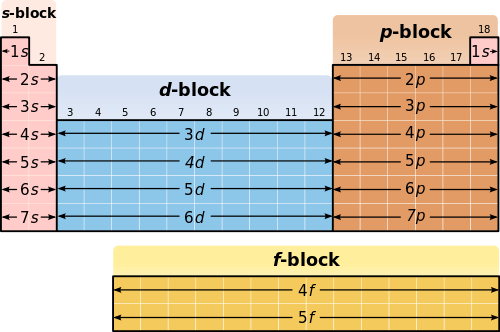
The periodic table can be separated into three blocks; s, p and d blocks. The s-block is comprised of elements who's last sub-shell is an s sub-shell and so on...


So, if we pick out phosphorus (P) for example, as we know it is in the p block, its last occupied sub-shell would be the 3p and as it is three places into the p block, the 3p sub-shell would have an occupancy of 3, so 3p3. Overall the spd notation of phosphorus would be 1s22s22p63s23p3.

In summary:
  • Electrons fill the lowest energy sub-shell first.
  • Electrons fill sub-shells until they are half full and then pair with electrons of opposite spin to fill the sub-shell.
  • An element's position in the periodic table can tell you its electron configuration. 


Sunday, 30 September 2018

A Level - A GCSE Chemistry Teacher's Biggest Lie!

Yes, we lied to you at GCSE - electrons don't really orbit the nucleus! Why did we do it? Well, imagine we taught you about what really happens in year 10 we probably would've brought you to tears!

The good news is that there are still shells; but these shells are divided into sub-shells which contain one, three or five orbitals (at A Level) and they don't follow the 2,8,8 rule. Described simply, an orbital is a region of space within an atom which can hold up to two electrons of opposite spin. From a mathematical perspective, the total probability of finding one or more electrons anywhere within a specific orbital is always equal to one. 

What is spin I hear you ask? Spin is a property of an electron that allows it to pair with another of opposite spin - i.e. an electron with 'up-spin' can pair with one with 'down-spin'. It doesn't play that big part at A Level, so there's no real need to go into it beyond what has just been said. 

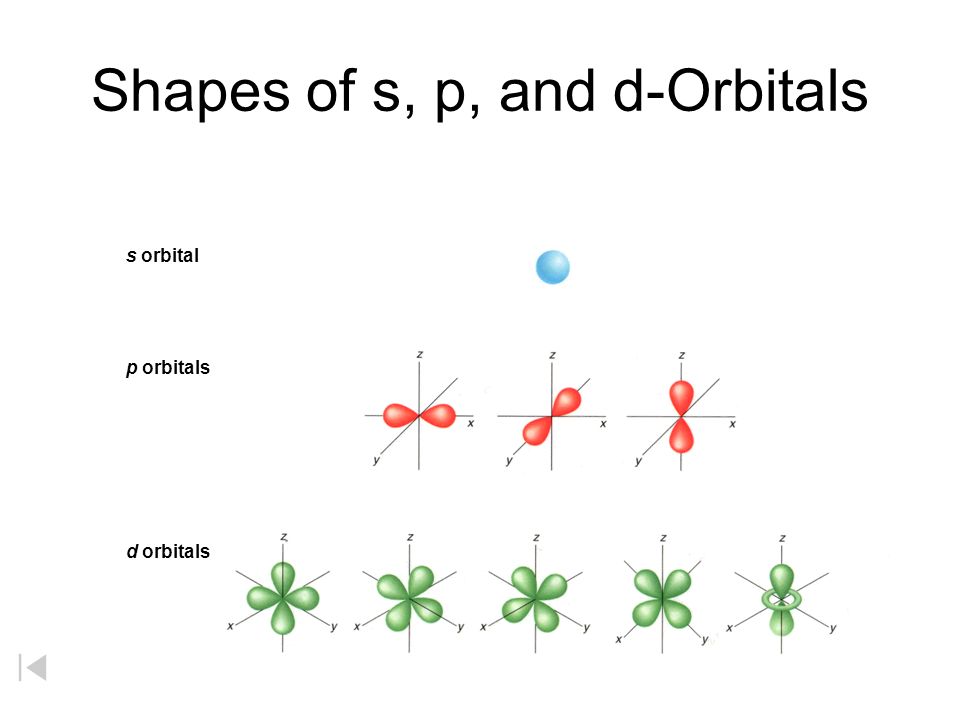
There are three different types of orbital which you need to be aware of at A Level:

  • s orbitals - spherical in shape, with an area of zero electron density at the centre (where you'd find the nucleus). s orbitals are so named after their historical name; 'sharp'.
  • p orbitals - comprised of two separate balloon-shaped lobes, with an area of zero electron density in the centre (again, where you'd find the nucleus). These orbitals sit along the x, y and z axes. p orbitals are so named after their historical name; 'principal'.
  • d orbitals - each is slightly different in shape or orientation, but all with an area of zero electron density at the centre (...where you'd find the nucleus). d orbitals are so named after their historical name; 'diffuse'.


At A Level, most exam boards will expect you to be able to draw s and p orbitals (with axes), but not d orbitals - so don't worry about them too much.

As previously mentioned, orbitals are arranged into sub-shells. where each type of sub-shell is comprised of a specific number of certain types of orbitals:

  • s sub-shell; contains one s orbital, which can accommodate up to two electrons of opposite spin.
  • p sub-shell; contains three p orbitals, each accommodating up to two electrons each, so six in total.  
  • d sub-shell; contains five d orbitals, each capable of accommodating up to two electrons each (of opposite spin) and hence a maximum occupancy of ten electrons.

The principal quantum number, often referred to as 'n', denotes the shell number. If an element has a principle quantum number of 1, that means that its valence (outermost) electrons are within the first shell. Each shell can hold a different number of electrons (maximum occupancy):

  • n = 1; first shell - contains 1 x s sub-shell (2) and therefore the maximum occupancy is 2.
  • n = 2; second shell - contains 1 x s sub-shell (2) and 1 x p sub-shell (6), therefore the maximum occupancy is 8.
  • n = 3; third shell - contains 1 x s sub-shell (2), 1 x p sub-shell (6) and 1 x d sub-shell (10), therefore the maximum occupancy is 18.

With regards to the fourth shell (n = 4), you only need to be aware of the s sub-shell within it at A Level. 

The orbitals inside an atom get progressively larger, so an s orbital in the third shell (3s) is larger than an s orbital in the first shell (1s). The sub-shells are arranged in terms of increasing energy, and rather bizarrely, the s sub-shell in the fourth shell (4s) actually has a slightly lower energy than the d sub-shell in the third shell (3d), as illustrated below:


So, that summarises the way in which electrons are arranged at A Level. In our next blog, we will start to unpick how these orbitals are filled, the common way to represent electron configurations, how to abbreviate them and the exceptions to the rules.